

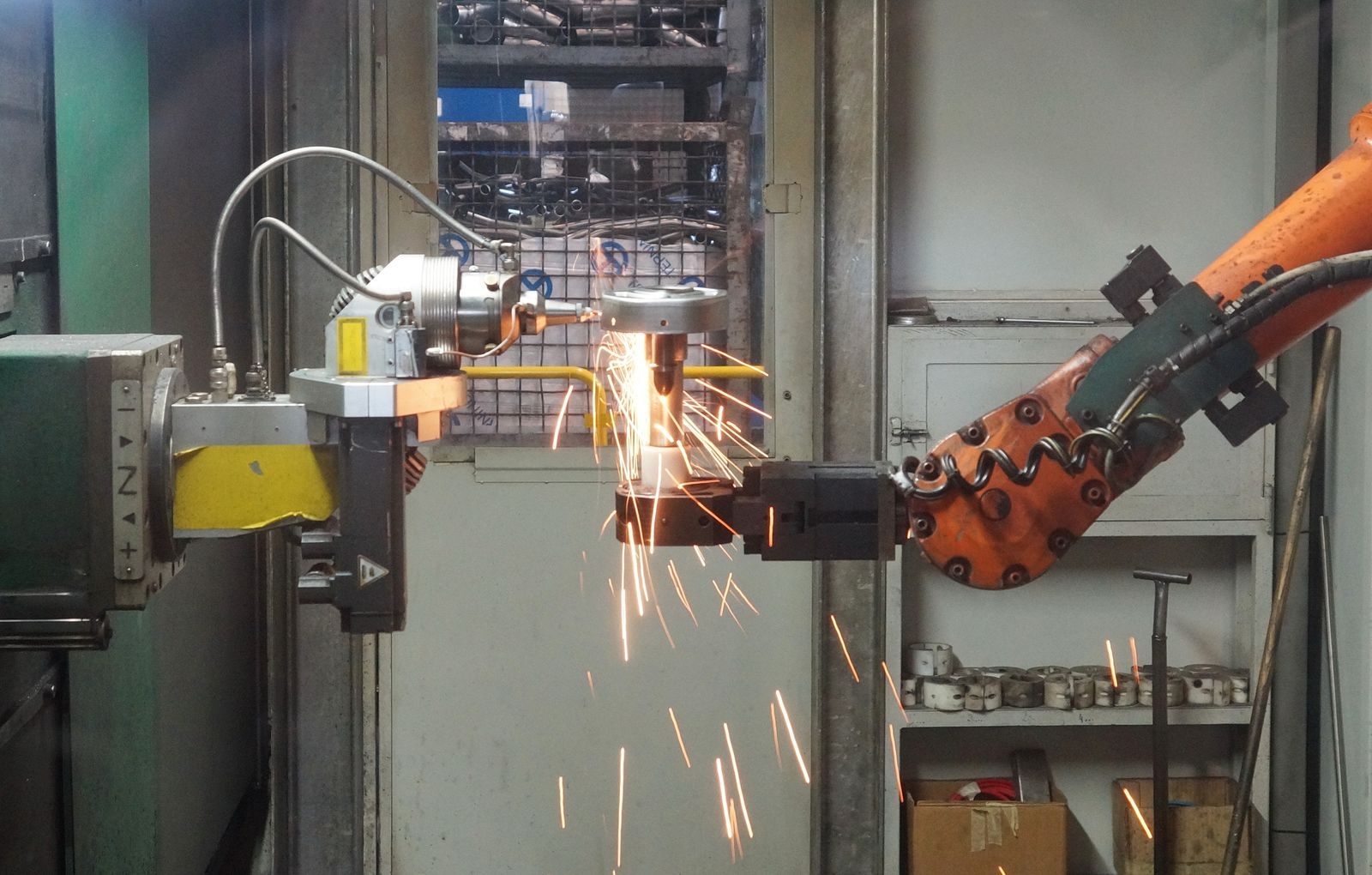
A fabricator with two or three welders can hold quality on a few parts a day. The moment the same part repeats in the hundreds, manual welding becomes the bottleneck: it depends on who is on shift, how tired they are, and how consistent their technique stays across a long run. A robotic welding cell removes that variation by repeating a programmed path the same way every time, which is why the question is rarely "is robotics better" and almost always "does the volume justify the fixture and the programming".
A cell is more than a robot arm. The arm holds the torch; a positioner or turntable presents the part so the weld is made in the most accessible orientation; a fixture locates and clamps the part so it cannot move; and a controller stores the program and the weld parameters. Miss any one of those and the cell does not weld well, no matter how good the arm is. The fixture and the positioner are where most of the engineering effort goes, because they decide whether the robot can actually reach every joint cleanly.
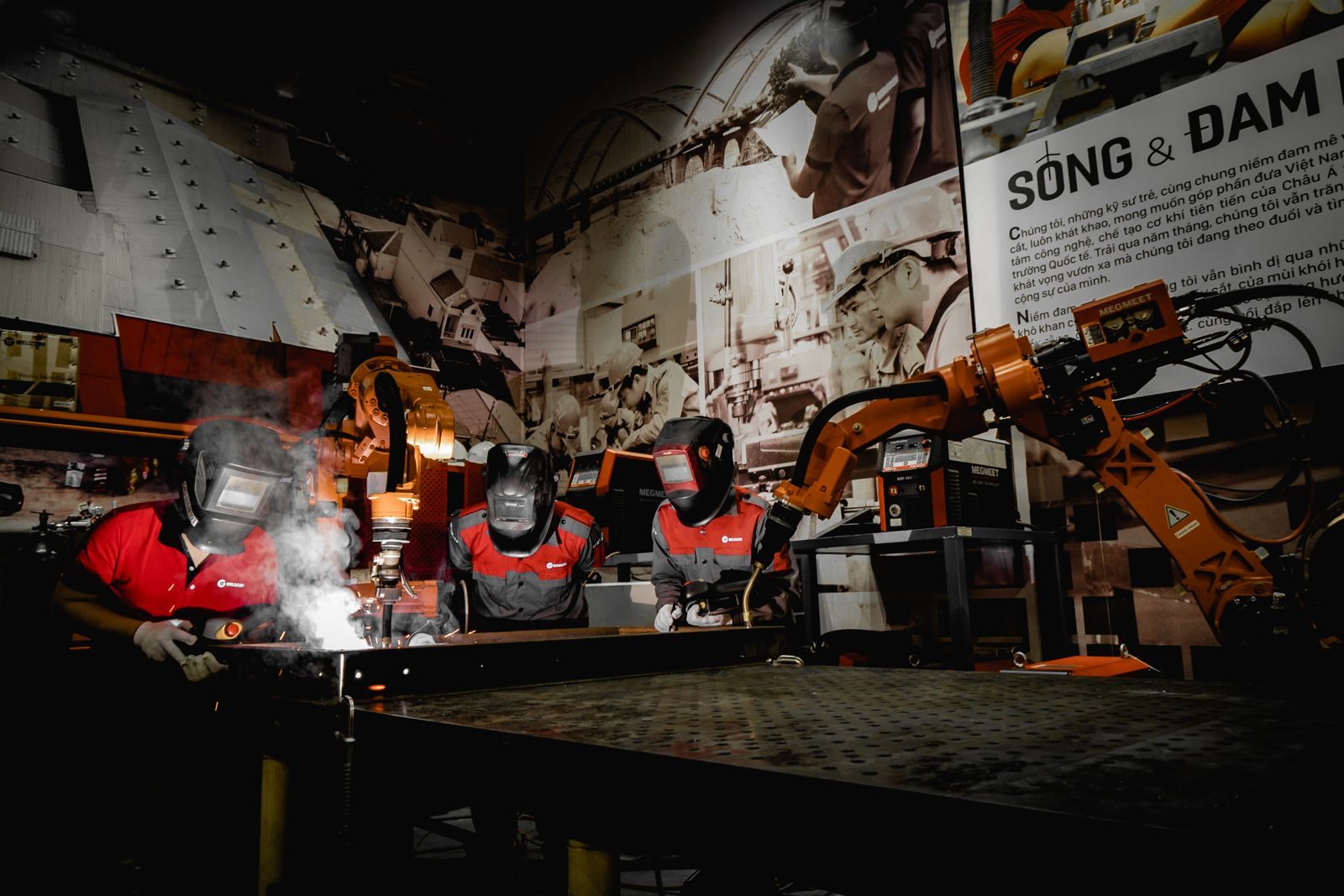
Suppliers such as robotic laser welding and cutting system builders normally quote a cell around a specific part rather than as a catalogue item, because the fixture and the reach define the machine more than the brand of arm does.
There is no magic number, but the economics are consistent. A cell carries a high fixed cost - the arm, the positioner, the fixture, the integration - and a low variable cost per part. Manual welding is the reverse: low setup, higher per-part cost that grows with rework. The crossover sits where the repeated volume spreads the fixture cost across enough parts that the per-part price drops below manual welding including its scrap.
| Situation | Usually the better route |
|---|---|
| One-off or a small prototype batch | Manual welding; the fixture cost alone would dominate |
| A part that repeats in the low hundreds, stable design | Consider a dedicated or semi-automated cell |
| A part in the thousands with a fixed design | Robotic cell; the fixture pays for itself across the run |
| A design that changes every quarter | Manual or a re-fixturable cell; a rigid fixture becomes obsolete |
The honest version of the calculation compares total cost over the expected program life, including the redesign cost if the part changes. A fixture built for a part that is revised next year is an expensive paperweight.
The robot is rarely the expensive part. The fixture is, because it has to locate the part to the same accuracy the weld needs, hold it against shrinkage, and let the operator load and unload quickly. Two design choices decide most of that cost.
| Part profile | Fixture approach | What it costs |
|---|---|---|
| Flat or open fabrication | Pin and block locating on a plate | Low; often reusable elements |
| Box or frame section | Dedicated clamping nest | Moderate; one-off machining |
| Complex 3D shape | Contoured fixture with pneumatic clamps | High; designed and proven per part |
| Family of similar parts | Adjustable or modular fixture | Higher upfront, lower per-variant |
Where a family of parts shares a locating scheme, a modular fixture that adjusts between variants is far cheaper than a dedicated fixture per part. That is the difference between a cell that pays for itself and one that does not.
A robot repeats the program, not the part. If the fit-up varies, the weld varies, and no controller fixes a gap it was not programmed for. Three rules decide most of the result.
Designing the joint for the machine - a defined weld flange, a consistent root gap, an accessible angle - is the highest-value change before any cell is ordered, and it costs nothing in material.
Automation amplifies the input. A poorly cut part locates badly, welds badly, and does so consistently. Because cut quality sets the baseline for everything downstream, the parts fed to a cell should come from a process that holds edges and hole positions repeatably - which is why laser-cut blanks are the usual feedstock for a welding cell rather than hand-cut plate.
Inspection still matters. A cell should be proved on a first article and then sampled, because a drift in fixture wear or torch calibration shows up across the whole run at once. Catching it on one part is cheap; catching it on a pallet of finished parts is not.
Send the part model, the drawing with functional tolerances, the expected annual volume and program life, the material and thickness, and the joints that actually carry load. Say which dimensions must be held after welding and which can be machined afterwards. An integrator who knows the part repeats forty thousand times will invest in a fixture and a positioner; one who believes it is a one-off will propose something that never pays back.
Ask what the cycle time is per part, how the fixture is loaded, what happens when a torch needs changing, and how the cell is proved before you accept it. Those four answers show whether the proposal is a production tool or a demo.
There is no universal threshold; it depends on fixture cost and program life. Below a few hundred repeat parts a dedicated fixture rarely pays; above several thousand it usually does, provided the design is stable. The only reliable answer comes from pricing the cell against manual welding for your specific part and volume.
Often, if the parts share a locating scheme or the fixture is modular. A cell built around a single rigid fixture is tied to that one part; a cell built around an adjustable fixture can absorb a family of variants, which is usually the better investment when the catalogue is still growing.
It changes the skill, it does not remove it. Someone still sets up the cell, proves the first article, maintains the fixture and reacts when a joint drifts. The work moves from the torch to the fixture and the program, which is where consistency comes from.
At ZH Industrial Machinery we treat welding cells as part of the equipment specification rather than a separate purchase, because the fixture and the frame it welds have to be designed together. If you are repeating a fabricated part in volume and the manual weld is becoming the bottleneck, send us the part and the quantity and we will propose a route.
The process case rests on the characteristics of laser welding as against arc processes. The enclosure and interlock requirements are not optional: a Class 4 laser cell has to meet the controls published by the US Occupational Safety and Health Administration, and the robot itself falls under the same body's machine guarding guidance.