

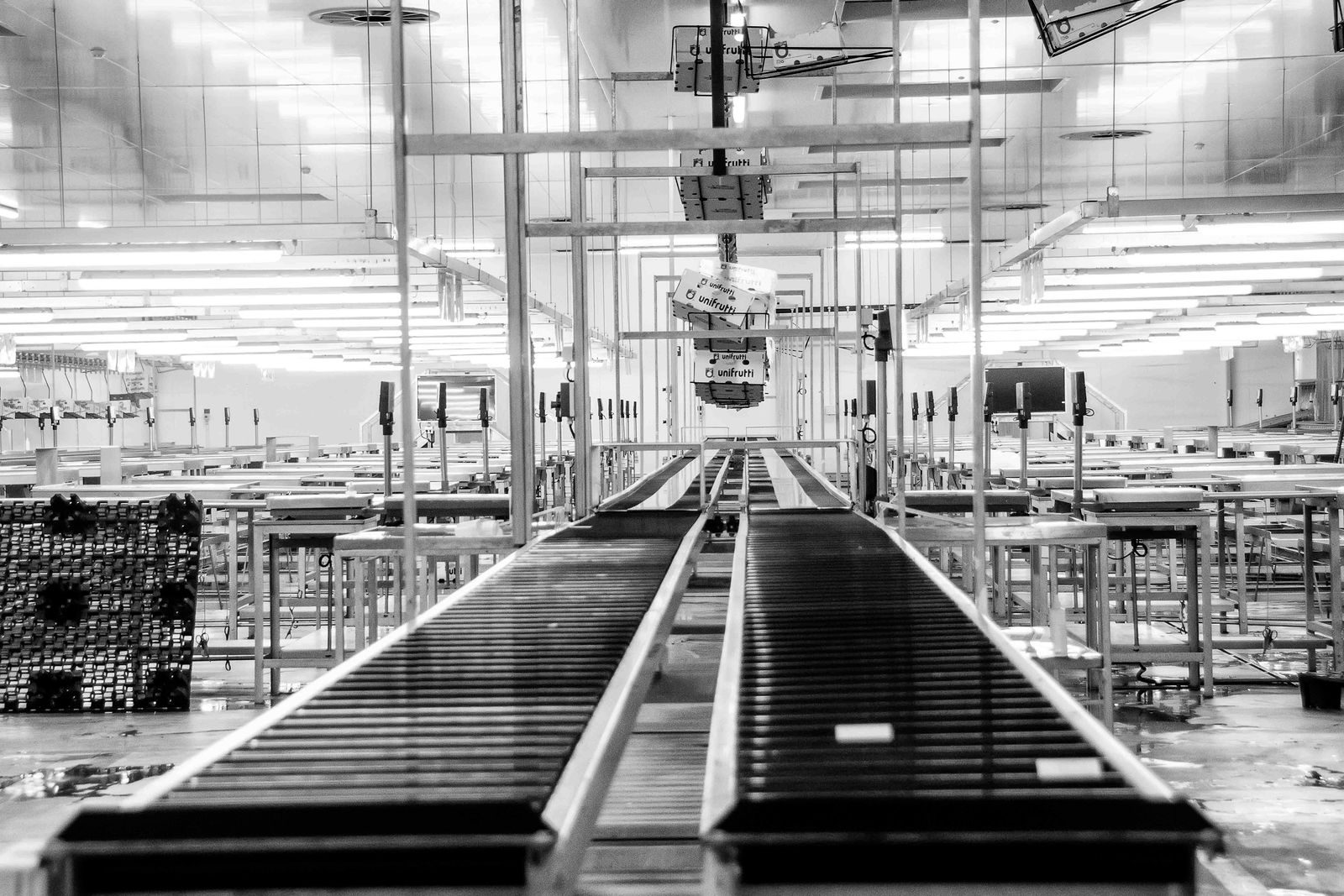
A conveyor rarely stops because something broke. It stops because the belt has drifted to one side, a roller has seized, a splice has opened, or a photo-eye has become blind under a film of dust. Those are the accumulating conditions that turn a running line into a stopped one, and they arrive gradually rather than suddenly, which is exactly why they get ignored until the stop happens.
The distinction matters because it changes what a maintenance programme should do. A programme built around replacing failed components is reacting to events. A programme built around inspecting for the conditions that precede those events is preventing them, and on a conveyor the conditions are visible long before the stop.
A belt that runs off to one side is the most common conveyor complaint, and the most commonly mistreated. Adjusting the tracking idlers until the belt recentres treats the symptom; the cause is usually one of a short list, and it will move the belt again.
| What you see | Usual cause | What to check first |
|---|---|---|
| Belt drifts to one side along the whole run | The structure or the pulleys are not square or level | Frame squareness, pulley alignment, and the level of the supporting structure |
| Belt drifts in one section only | A seized or misaligned idler, or a build-up of material on a roller | Turn each idler by hand; look for a flattened or fouled roller |
| Belt wanders back and forth | Uneven loading, or a belt that has been over-tensioned | Loading point position and the tension setting against the belt data |
| Belt edge fraying on one side | Long-standing misalignment, or a protruding structure | Clearance along the full run, including guards and skirts |
Tension is the variable most often set by feel. A belt over-tensioned to stop a tracking problem loads the bearings and the splices and shortens their life, and a belt under-tensioned slips under load and wears the pulley lagging. Both are specifiable from the belt manufacturer's data, which is why that data belongs in the maintenance file rather than in a drawer.
Idlers and rollers are the components that carry the whole installation, and they are the cheapest thing on the line to inspect and the most expensive to ignore. A roller that no longer turns freely drags on the belt, abrades it, and creates the temperature rise that eventually seizes it completely. Because a conveyor may have hundreds of them, the practical approach is to survey rather than to inspect individually: walk the line while it is running and look for rollers that are not turning, or that are hotter than their neighbours.
Splices are the other item with a predictable life. A mechanical splice can be inspected visually for pulled staples and open gaps; a vulcanised splice should be checked for edge separation and for the change in surface height that indicates the bond is failing. A splice that is caught early can be re-done in a planned window; a splice that opens under load damages the belt and sometimes the structure.
Belts rarely fail in the middle of a straight run. They fail where material is dropped onto them and where it is transferred away. Impact at the loading point punctures and abrades the top cover, and a chute that discharges at the wrong angle or onto an already-moving belt causes the skew that shows up later as a tracking problem.
The three things worth checking at a transfer point are the height of the drop, the alignment of the load with the belt centreline, and the condition of the skirt rubber and the wear liners. Skirt rubber that has worn away lets fines escape and build up on the return strand, and that build-up is a common and easily fixed cause of mis-tracking. Wear liners that have worn through start wearing the chute instead, which is a considerably larger repair.
An automated conveyor depends on sensors telling the control system where product is. A photo-eye that has become coated with dust reads as permanently clear or permanently blocked, and the line then either runs product into a jam or stops for no reason. Because these faults look like control faults, they are often investigated as control faults, and the actual cause is a lens that has not been cleaned.
The maintenance schedule should therefore include the sensors, not only the mechanical parts. Clean the lenses, check the mounting is still aligned, and confirm that the sensor still detects at the far edge of its range. Where a line has a variable-frequency drive, the fault history it has logged is worth reading: a drive that has been tripping on over-current or over-temperature has been recording a mechanical problem in electrical language.
Conveyor maintenance competes with production for access, and the honest constraint is that the line has to stop for anything significant to be done. That makes two things matter more than the maintenance itself: knowing which work can be done running and which cannot, and having the parts on the shelf before the window opens.
A practical split is three tiers. Running checks - belt tracking, roller survey, sensor condition, unusual noise - need no stoppage and should be routine. Short planned stops cover belt tension, skirt rubber, liner inspection and small splice repairs. Long stops are for pulley and gearbox work, belt replacement and structural repair, and they need a spares position agreed in advance. A system that has been designed and specified around the real duty and the real product mix is easier to keep in this rhythm, because the running clearances and capacities are known rather than guessed - which is the design work a sortation specialist such as TrueLiSort does before a line is built.
For each conveyor, record the belt specification and tension setting, the idler type and positions, the splice type and its date, the drive and gearbox details, and the sensor configuration. Then record the interventions: what was adjusted, what was replaced, and what was observed but not yet acted on.
The last category is the most valuable and the most commonly skipped. A roller that is warm but still turning, or a splice edge that has started to lift, is information that should be carried forward rather than rediscovered. A maintenance file that records only what was fixed hides the problems that are still coming, which is the opposite of what the file is for.
The running checks are worth doing as often as the operation allows, because they need no stoppage and catch the conditions that precede a failure. Formal inspection intervals depend on duty: a belt moving abrasive material at high tonnage degrades far faster than one handling boxes, so the interval should be set from the observed wear rate rather than from a generic schedule.
Only if tension was the cause, which it usually is not. Over-tensioning to control tracking is a common short-term fix that loads the bearings, the shaft and the splice, and it rarely holds. Tracking problems are normally alignment, a seized roller or uneven loading, and those are what should be corrected.
When the damage extends beyond the splice itself. A mechanical splice with a few pulled staples can be re-pinned; one where the belt edge has torn away needs the belt cut back and a new splice made. A vulcanised splice showing edge separation should be re-done before it opens under load, because a splice that fails running damages the belt and sometimes the structure around it.
Conveyors reward inspection more than they reward repair, and most of what stops a line is visible while it is still running. ZH Industrial Machinery supplies and supports industrial machinery, and we are glad to review a site's conveyor inspection routine, belt specifications and spares position before the next unplanned stop rather than after it.
The equipment described here sits within the general account of the conveyor system, whose carrying components are bearings. The vibration and temperature signals that precede a roller or bearing seizure are covered under vibration. The guarding and safe-access duties around powered conveyors are the general obligation published by the US Occupational Safety and Health Administration, and equipment specifications normally cite ASTM International standards.