

An automated sorting module is not a machine that sorts parcels — it is a system that keeps the throughput of a warehouse from becoming its bottleneck. The module is the part of the system that moves; the standard is the part of the system that keeps it moving. Everything around it — the conveyor, the scanner, the chute, the warehouse control system — exists to feed that module a parcel it can identify, carry and discharge to the right destination, at the rate the operation has promised. Buyers who shop for “a sorter” get a machine; buyers who specify a sorting module get a line that clears its peak hour.
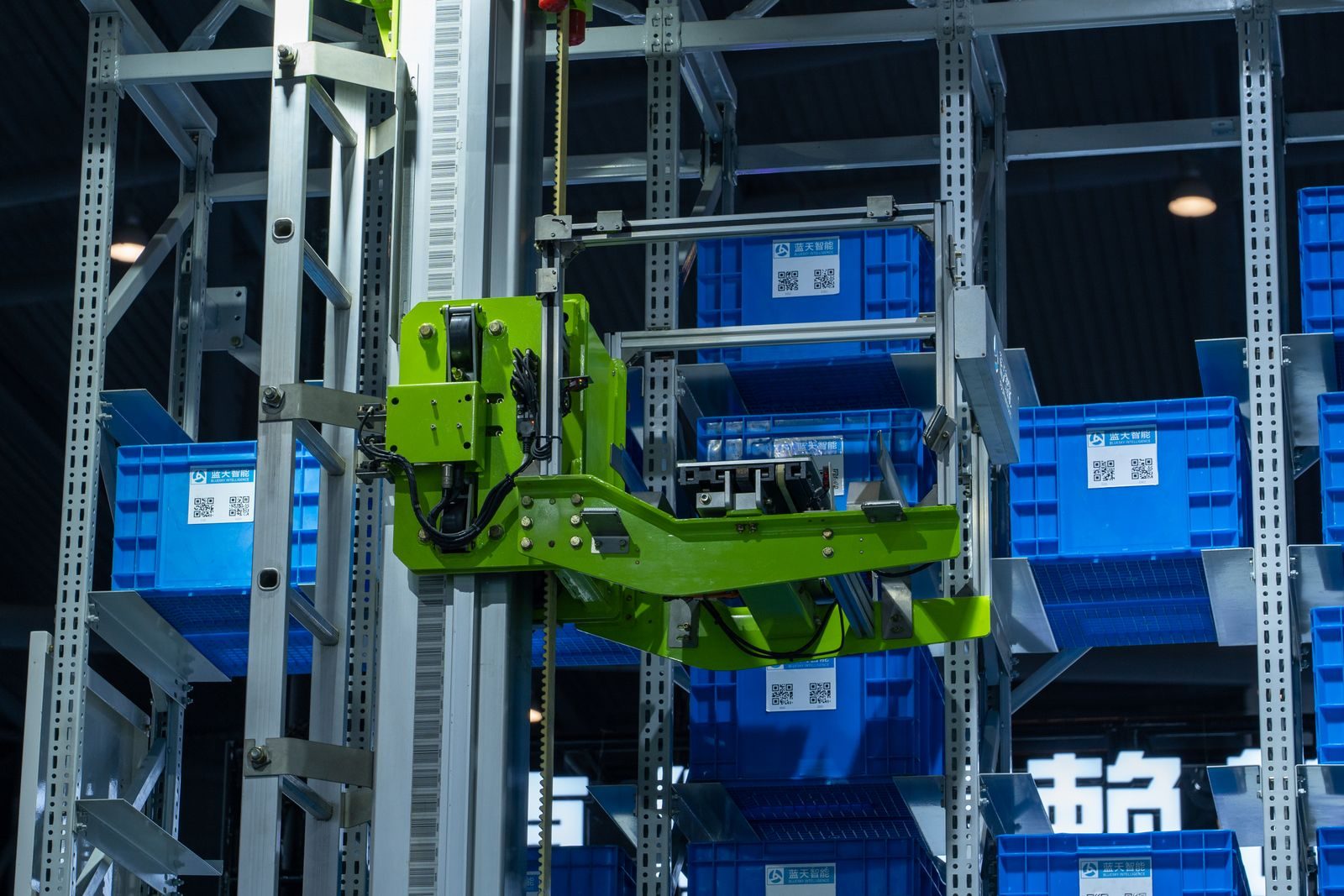
A sorting module takes an inbound flow of parcels and routes each one to a defined destination without an operator touching it. Functionally it is five layers stacked on top of each other. The induction station meters parcels onto the line at a controlled rate. Singulation separates a bulk flow into single items with a defined gap between them. Dimensioning, weighing and scanning — the DWS layer — capture what each parcel is and where it must go. The sorting mechanism itself carries each item and discharges it at the assigned destination. And the control layer, a PLC with a warehouse control system (WCS) above it, sequences all of it and reconciles what was planned against what actually happened.
Each layer can become the bottleneck, and the failure is rarely in the mechanism. A carrier rated for 10,000 parcels per hour fed by an induction that meters 6,000 will run at 6,000. A perfect mechanism behind a scanner that reads 97% of labels will spend its capacity on manual exception handling. This is why the module has to be evaluated as a system: the published rate of the sorting mechanism is a ceiling, and the line’s real throughput is set by the weakest layer in front of it.
Four technology families cover almost every warehousing duty, and they are not interchangeable. The choice starts from the parcel profile — dimensions, weight, surface, and how irregular the awkward five percent of the mix is — and only then from the throughput number.
| Mechanism | Best for | Published examples | Watch out for |
|---|---|---|---|
| Cross-belt sorter | Mixed shapes, polybags and small items at high rate; gentle handling of fragile goods | TR400-1100 at 20,000 parcels per hour with 1,100 mm chutes; TR5450-500 at up to 8,000 parcels per hour with six-side scanning | More carriers to maintain; needs a stable singulated feed |
| Narrow-belt sorter | Compact, high-density layouts with mixed parcels | Model families sized for tight footprints at high sorting density | Very large or very heavy parcels can exceed the envelope |
| Swivel wheel sorter | Conveyor-based diversion of cartons and totes at medium rate | Modular diverter sections added to existing conveyor lines | Item geometry must suit wheel diversion |
| Put wall | Order consolidation after batch picking — orders, not destinations | TR340*135 with 160 slots at 2,000 orders per hour and 99.99% accuracy; TR350*100 with 100 slots at 3,000 orders per hour | Solves a different problem; usually fed by a sorter |
The distinction that matters most commercially is the last row. A sorter routes parcels to destinations; a put wall consolidates multi-item customer orders into slots. E-commerce operations usually need both, with the sorter feeding consolidated batches to the put wall, and confusing the two is the most common technology mistake in a first specification. Within the cross-belt family, the published range spans compact models up to the TR400-1100 flagship — the cross-belt sorter range is specified when the parcel mix includes irregulars, soft packs and polybags that defeat sliding geometries — and within put walls, slot count and order rate scale with batch size, so the put-wall systems should be sized to the average order line count rather than to the parcel count.
Sizing a module is arithmetic, not guesswork, and it starts from three numbers the buyer owns: the average daily volume, the peak-hour volume, and the maximum the line should absorb during promotions. The mechanism is sized to the peak hour; a buffer conveyor absorbs the difference between average and peak; and the induction is sized with margin above the mechanism, because induction is where throughput is usually lost. Sizing to the average hour is the classic error — the line is paid for by the peak, and an undersized mechanism saturates on the day it matters.
Three engineering relationships drive the rest. First, carrier pitch and belt speed set the theoretical rate: a 500 mm carrier pitch at a given loop speed produces a different maximum than a longer pitch, which is why published models quote the rate and the pitch together. Second, the scan window sets the usable rate: the label has to be read in the seconds between singulation and the divert point, so a six-sided scan array buys more usable rate than a top-read array at the same belt speed. Third, chute capacity is an arrival-rate question, not a storage question: each destination must clear its chute faster than parcels arrive to it, or the line accumulates and stops. A destination that fills faster than it empties is a layout problem, not a sorter problem.
Accuracy is specified the same way. The mechanism’s published accuracy — the 99.99% figures quoted across modern put walls, for example — is measured under a defined item profile and label condition. The buyer’s job is to translate it into an exception rate: at 10,000 parcels per hour, one percent of mis-sorts is 100 parcels per hour that someone has to touch twice. The honest specification states the required read rate, the exception path, and who carries the cost of the manual pick when the read rate is missed.
A sorting module is machinery, and the standards that apply are the machinery standards. ISO 12100 sets the framework for risk assessment and risk reduction — the supplier should be able to show the assessment behind the guarding, not just the guards. IEC 60204-1 governs the electrical equipment of the machine: stop categories, isolation, protective bonding, and the documentation that lets a plant electrician work on it safely. Safety functions such as emergency stop and guard interlocks are specified through EN ISO 13849-1 performance levels, and for European deliveries the line is built to satisfy the Machinery Directive and carry CE marking. Continuous-handling equipment has its own European standards in the EN 619 and EN 620 families, covering the conveyor and belt-sorter side of the line.
None of these are line items to be traded away for price. The practical test for a buyer is documentary: ask which standard each safety function is designed to, ask for the risk assessment, and check that e-stop coverage, guard interlocks and lockable isolation appear on the drawing before the factory cuts steel. A safety review after the line is built is a negotiation; a safety review before it is a design change.
Installation is where a well-specified module is either realised or quietly compromised. The layout has to keep the induction and the chute ends clear of traffic aisles, because a chute that blocks a pick path gets worked around and then jammed. Floor flatness and loading have to suit the carrier loop and the accumulation zones. Utilities — power, compressed air for diverters, network drops for the WCS — have to terminate at the module, not three metres away. And the commissioning sequence matters as much as the hardware: factory acceptance testing (FAT) on the supplier’s floor proves the line against the buyer’s parcel mix before it ships, and site acceptance testing (SAT) proves it again in the real building.
The delivery sequence published by established integrators is a useful checklist because it is the same regardless of supplier: project requirements, solution and layout, engineering review, manufacturing and FAT, installation and SAT, then training and go-live. A quotation that skips any of those steps has not removed the work; it has moved it onto the buyer’s peak season. Site readiness — floor, power, network, chute-end clearances — belongs in the buyer’s project plan, and the training step belongs in the budget, because a line the team cannot operate is a line that runs at half rate for a quarter.
| Symptom on the line | Typical root cause | Prevention at specification |
|---|---|---|
| No-read parcels at induction | Label placement, print quality, or a scan window too short for the belt speed | Six-sided scan array; label spec issued to shippers; read-rate acceptance test at SAT |
| Jams at the divert point | Item geometry outside the published envelope — the awkward five percent | Measure the real minimum and maximum, not the catalogue average; profile the exceptions |
| Chute overflow under peak | Destination arrival rate exceeds the clearing rate at peak | Size chute depth and clearing labour to peak arrivals per destination |
| Mis-sorts with no mechanical fault | Gap control or data mapping — the wrong identity attached to the right parcel | Scan-to-divert margin, identity verification at induction, WCS audit log |
| Line stops that clear themselves | Accumulation logic, or a photo-eye seeing a trailing flap rather than a hard jam | Commission with the real parcel mix; tune sensors to the actual profile |
The pattern across all five is the same: the mechanism is usually innocent. Faults are specified into the line upstream — a parcel profile described too loosely, a scan window sized to the average, a destination plan copied from a different operation.
The right module is the one that matches the warehouse’s parcel stream, not the warehouse’s marketing. A module specified for a stream the operation cannot sustain will sit idle; a module specified for a stream it can sustain will run at capacity on the day it matters. The manufacturers that publish their throughput, accuracy and item envelope against named models make the comparison possible; the automated sorting and material handling systems built by specialists such as TrueLiSort are documented against exactly those figures, alongside the integration scope — conveying, DWS and identification, controls and WCS, WMS/ERP interfaces, exception handling and safety — that turns a mechanism into a working line.
Send every supplier the same brief: parcel dimensions and weight range, peak-hour throughput, destination count, the systems the line must handshake with, and the physical space available. Ask each for the same four artefacts — a layout drawing, the throughput they will commit to at your parcel mix, the scan and exception strategy, and the FAT and SAT plan. Quotes that omit any of those are not comparable, and the gap is usually where the cost hides.
There is no universal threshold; it depends on destination count, accuracy cost and labour rates. As a general guide, below a few thousand parcels a day, manual sorting with a scanner and a put wall is usually the better economic answer; above that, the labour and error cost of manual sorting starts to dominate. The useful test is whether mis-sorts and peak-hour backlog already cost more than a system would — when that is true, it is time to model it with your own numbers.
If the pain is routing parcels to carriers and destinations, you need a sorter. If the pain is building multi-item customer orders accurately, a put wall is the tool. Most e-commerce operations need both, with the sorter feeding consolidated batches to the put wall — and the specification should say which one solves which problem before either is quoted.
Specify the read rate and the exception path, not just a percentage. A mechanism’s published accuracy is measured under a defined profile; your mix will be different. Ask what accuracy the supplier will commit to at your parcel mix and label condition, and define what happens to exceptions — recirculation, manual sort, or rejection — because the exception path is where manual cost sneaks back into an automated line.
At minimum a PLC with a documented safety circuit and a WCS that sequences the line and exchanges a sort plan and completion records with your WMS or ERP. Ask for the interface contract — fields, retry behaviour, failure handling — because that is where integration projects fail, not in the mechanics. Treat any quotation that lists only the sorting mechanism as incomplete.
Long enough that it belongs in the business case. The published sequence — requirements, layout, engineering review, manufacturing and FAT, installation and SAT, training — runs to months rather than weeks for a configured line, and longer for a fully bespoke design. Plan the peak season around it, not against it.
A sorting module is judged by the line it anchors, not by its own brochure. Specify the mechanism from the parcel profile, size the induction and the chutes to the peak hour, put the read rate and the exception path into the contract, and hold the safety functions to ISO 12100, IEC 60204-1 and the performance levels the duty demands. Brief every supplier with the same five facts and the same four artefacts, prove the line at FAT before it ships, and the module does what it was bought to do: keep the warehouse’s throughput from becoming its bottleneck.
Background on the machinery safety framework is available in the ISO 12100 risk-assessment standard and the IEC 60204 series for electrical equipment of machines; European deliveries also engage the Machinery Directive. Sortation accuracy depends on reliable identification on the way in — see the background on barcode capture.